
SCIENTIFIC DIASPORA · SCIENCE HUBS · MENTOR STORIES
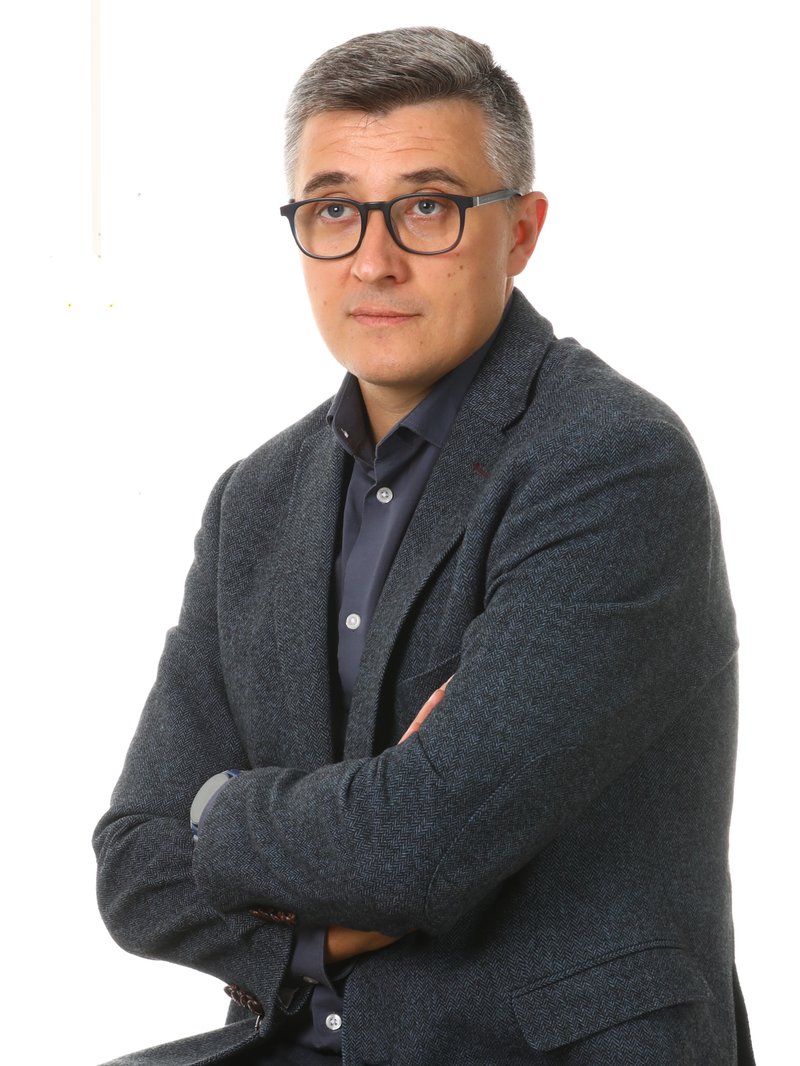
Ivan Hetman is an analytical chemist shaped by the Kyiv scientific school, who made his way through the pharmaceutical industry and a postdoc in northern Sweden, and today works at the meeting point of a university and a university hospital in Linköping. A laureate of Sweden’s A-Pro programme and one of our community’s mentors for its science hubs, he shares what he has learned with those building a research career away from home.
Interview by Dr Tetiana Suvorova – Association Bernard Gregory
The Ukrainian scientific diaspora is not only a geography of departures; it is a network of people who keep doing science while staying connected to home and to one another. Ivan Hetman is exactly such a figure. His trajectory shows that a researcher’s career is rarely a straight line – more often a sequence of crossings between countries and sectors. We spoke with him about his path, his work in Sweden, and his advice for those just starting out.
Your path
“It all began with a doctorate in Kyiv, at the Institute of Colloid Chemistry and Water Chemistry,” he recalls. A short research stay in Poland followed, then a blunt realisation: “Funding for Ukrainian science left much to be desired – and sadly it hasn’t improved since.” He moved into pharmaceutical R&D – “and I’ve never regretted it. Very well-equipped labs, high standards for quality, method validation, reliability of results. That experience gave me a great deal as a researcher.”
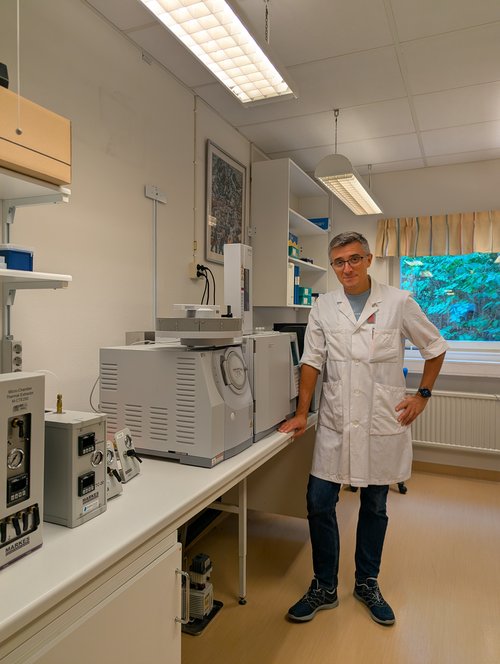
His career would shuttle several more times between academia and industry. It was in his pharmaceutical lab that he came across the postdoc route: “Many PhDs continue as postdocs, often in a different country from the one where they defended. I wanted to try it.” After many applications, he was offered a postdoc at Umeå University, in northern Sweden, on the remediation of groundwater contaminated by organic compounds and heavy metals. “That’s how my Swedish chapter began.” Today his project sits at the crossroads of two of his jobs: a laboratory of occupational and environmental medicine at Linköping University Hospital, and the Laboratory of Organic Electronics (LOE) at Linköping University.
What the A-Pro programme is
“It’s a programme for researchers who work in Sweden outside academia but want to build a closer link with a university – which is roughly what happened in our case.” His hospital lab holds strong analytical instrumentation; it began lending that capacity to colleagues at the LOE for their projects. “Then I saw the A-Pro call and thought: why not give it a go?”
« It funds not an isolated scientific project, but the link between a non-academic organisation and a university. »
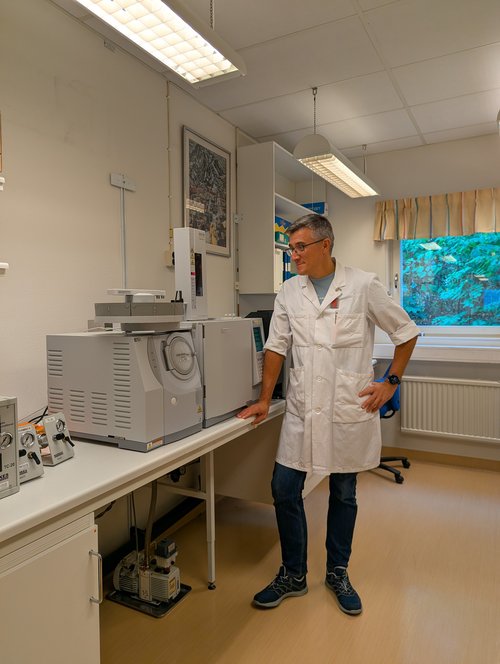
Part of the money offsets the researcher’s salary – decisive in Sweden, where payroll is a large share of any lab’s costs. In practice the laureate spends a fraction of their time at the university while keeping their main job outside academia; in his case, 20% at the university and 80% at the hospital. The application itself “wasn’t terribly hard – both the university and the hospital management embraced the idea, so letters of intent came together quickly. The demanding part was the project plan: bringing the hospital lab’s resources together with the university group’s scientific needs so the project would be genuinely useful to both.” His command of Life Cycle Assessment (LCA), a competence the university needed, helped seal it.
The science, in plain terms
Ivan gently corrects a common assumption: next-generation energy materials don’t necessarily need brand-new analytical methods. “More often, what’s needed is a deeper, more detailed chemical analysis using methods that are already well established.” As these materials are made – and later, as they operate – by-products can form and accumulate, signalling side reactions, for instance inside a battery. Analytical chemistry – ICP-MS, gas and liquid chromatography coupled with mass spectrometry – makes it possible to detect and characterise them. The materials, often polymeric, also degrade over time under heat, light or operating conditions. “I wouldn’t quite call them a black box – but fine analysis reveals what is really happening in the system, and why a process we counted on sometimes simply doesn’t work.”
A distinct strand is Life Cycle Assessment. “Too often a material or process is validated in the lab without anticipating how it will behave at real-world scale.” Solvents that are safe in small quantities can make a process environmentally unacceptable – even dangerous – at industrial scale. Close in spirit to the Safe and Sustainable by Design approach, LCA allows one to anticipate: less toxic substances, green-chemistry principles, risk reduction from the design stage, and an early check on whether a new process is genuinely greener than the one it would replace – “not just better lab numbers.” In his group, the horizon is batteries and energy storage: when solar and wind produce more than is needed, that surplus has to be stored for later – which calls for new materials, new devices and new processes.
Industry and academia: complementary, not opposed
“Academia is freer for scientific creativity; it works for the long term.” Industry, in return, teaches “a more exacting, more critical relationship with your own results. In pharma, the demands for reliability, reproducibility, validation and documentation are very high – and that mindset stays with you.” The collaboration, he stresses, rests not on opposing the two worlds but on their complementarity. Have the barriers vanished? He makes no such claim. In Sweden, some early-career (tenure-track) positions carry a maximum interval after the PhD, so years spent in industry can later close certain academic doors; conversely, industry can be wary of a profile that has stayed academic too long. “Programmes like A-Pro are precisely a way of lowering those barriers.”
A Scandinavian ecosystem
Why Sweden, why the LOE? “Sweden, simply because I live and work here, in Linköping.” The lab partnership arose by chance – an informal meeting with a colleague, shared scientific interests, “no grand official plan, more of a happy accident.” He found the Swedish system “extremely welcoming and legible,” a Nordic signature: strong horizontal ties within teams, far less hierarchy than many are used to, and few obscure formalities – “those that exist usually have a logical explanation.” Integrating, he says, was not hard.
Advice for those just starting out
“My answer won’t be very optimistic – I don’t regard my own path as ideal.” Decide as early as possible, he urges, ideally before the PhD even begins: if you want a life in science, do the PhD and build in academia; if industry, start-ups or applied work appeal more, develop in that direction from the outset. “We train far more PhDs than there are tenure-track posts. The competition is fierce.” And the odds of moving into the non-academic world are generally better right after the PhD than after several postdocs – each year sharpening an ever more “academic” profile that industry may eye with suspicion.
Would he advise a young researcher to engineer a “hybrid” career like his? “Frankly, no.” His own grew out of accumulated experience and an opportunity that arose at a certain stage. “Better to build a solid base in one direction first. Only then, once you know what you can bring to the other sector, do these crossings become truly fruitful. Trying to run two careers at once from the start risks spreading yourself too thin.” And a lighter closing note: “Life is always more complicated than any career plan – and that’s just as well.”
The A-Pro programme at a glance
- Scheme – Adjunct Professor / Adjunct Associate Professor from Industry (“A-Pro”), Swedish Foundation for Strategic Research (SSF).
- Who – established researchers employed outside academia – in industry, a public agency or a healthcare provider – seeking a closer link with a Swedish university.
- Principle – co-funded part-time appointment at a university (at least one day a week), over 2–6 years.
- Funding – up to MSEK 1.5, overheads included; the home organisation co-funds at least 10% of salary.
- Fields – natural sciences, engineering, medicine.
- Info and calls – www.strategiska.se
- Ivan Hetman’s project – “Analytical methods and LCA for sustainable energy materials,” Linköping University (LOE) & Linköping University Hospital, 2024–2030.
Why this story matters for the diaspora
Ivan’s experience is a reminder that the Ukrainian scientific school gives a solid foundation that works anywhere in the world, and that mobility across countries and sectors is not a loss but a way to grow skills and connections. People like him are what give our science hubs their value: they open doors, share practical knowledge of other countries’ grants and systems, and show younger colleagues real paths rather than idealised ones.