
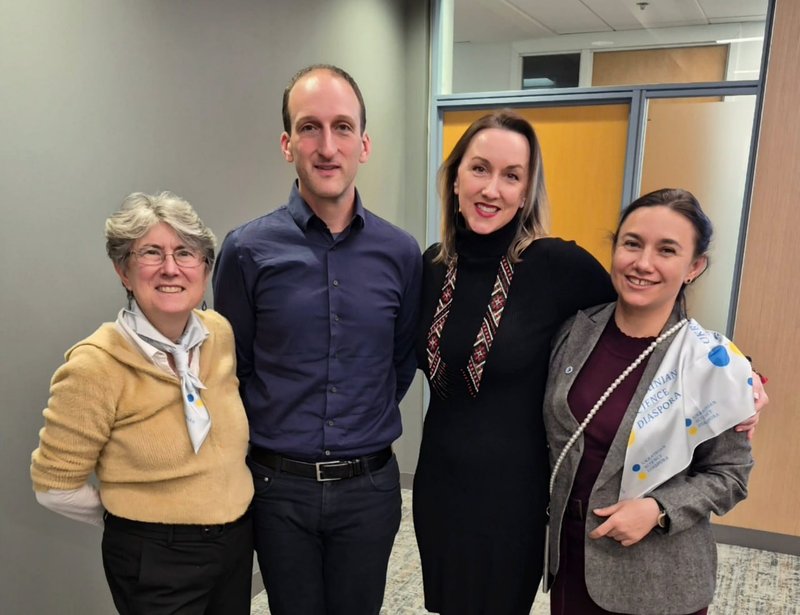
On October 21, 2026, the Massachusetts Institute of Technology (MIT), USA, hosted a discussion on supporting Ukrainian science during the war and strengthening practical cooperation between American and Ukrainian universities. Professor Yevheniia Polishchuk, Chair of the NGO Ukrainian Science Diaspora, participated in the event. One of the key outcomes was an agreement to establish a working group to explore opportunities for transferring research equipment from universities in Massachusetts to Ukrainian research institutions.
The meeting took place as part of the academic discussion "Science in Wartime Ukraine: Campus Engagement," held at the MIT Center for International Studies у Кембриджі, Massachusetts.
A particularly meaningful aspect of the visit was the opportunity to engage with a vibrant and supportive academic community that not only expresses solidarity with Ukraine but has already demonstrated its commitment through practical initiatives, including the transfer of research equipment to Ukrainian scientists.
Such efforts illustrate how international academic solidarity can translate into tangible support for laboratories, researchers, and universities that continue their scientific work despite the challenges of war.
During her presentation, Professor Polishchuk introduced the activities of the Ukrainian Science Diaspora, its international network, and the potential of Ukrainian scholars abroad to serve as bridges between institutions and facilitate long-term academic partnerships.
Today, the Ukrainian Science Diaspora network spans more than 30 countries across four continents and cooperates with 19 partner science diaspora organizations in 15 countries.
Special attention was given to the devastating impact of Russia's war on Ukraine's research infrastructure and the urgent need to restore scientific capacity.
Participants discussed how U.S. universities can support their Ukrainian counterparts not only through academic exchanges and joint research projects but also through the donation of laboratory instruments and research equipment that may no longer be in active use at American institutions but could remain highly valuable to Ukrainian researchers.
Professor Polishchuk also presented existing mechanisms that can facilitate such initiatives. Ukrainian research institutions can register their equipment needs through the national URIS platform, while international partners can use RI.Logistica to identify available equipment, connect donors with recipients, and support the organization of equipment transportation.
One of the most significant outcomes of the meeting was an agreement to establish a working group dedicated to exploring the potential for expanding research equipment transfers from academic institutions in Massachusetts to Ukrainian universities and research institutes.
The proposed initiative will focus on assessing opportunities within the academic ecosystem of Boston and Cambridge, including MIT, while exploring possibilities for engaging other universities and research institutions across the region.
In the longer term, this cooperation could lay the foundation for a broader program connecting American universities, Ukrainian scientists in the diaspora, logistics partners, and research institutions in Ukraine.
"What is particularly inspiring is that we are engaging with academic communities that are already taking action. For them, supporting Ukrainian science is not merely a statement of solidarity, but a commitment reflected in concrete initiatives, partnerships, and equipment donations. Our goal is to connect these efforts, engage more universities, and transform individual success stories into a sustainable framework for cooperation. After all, equipment that is no longer used in one laboratory may enable the next important scientific breakthrough in Ukraine," said Professor Yevheniia Polishchuk.
The Ukrainian Science Diaspora expresses its sincere gratitude to the MIT academic community for the warm welcome, meaningful discussions, openness to collaboration, and commitment to practical initiatives supporting Ukrainian science.
The meeting represents another step toward transforming international academic solidarity into lasting institutional partnerships — where scientists support scientists, laboratories support laboratories, and universities support universities.