Veterinary scientist · Experimental biology · One Health · Animal welfare and ethics
Sumy National Agrarian University, Ukraine · Institute of Parasitology, Biology Centre of the Czech Academy of Sciences, Czech Republic
ORCID: https://orcid.org/0000-0002-0761-3681
Scopus: https://www.scopus.com/authid/detail.uri?authorId=57204844670
Web of Science: https://www.webofscience.com/wos/author/record/U-9933-2018
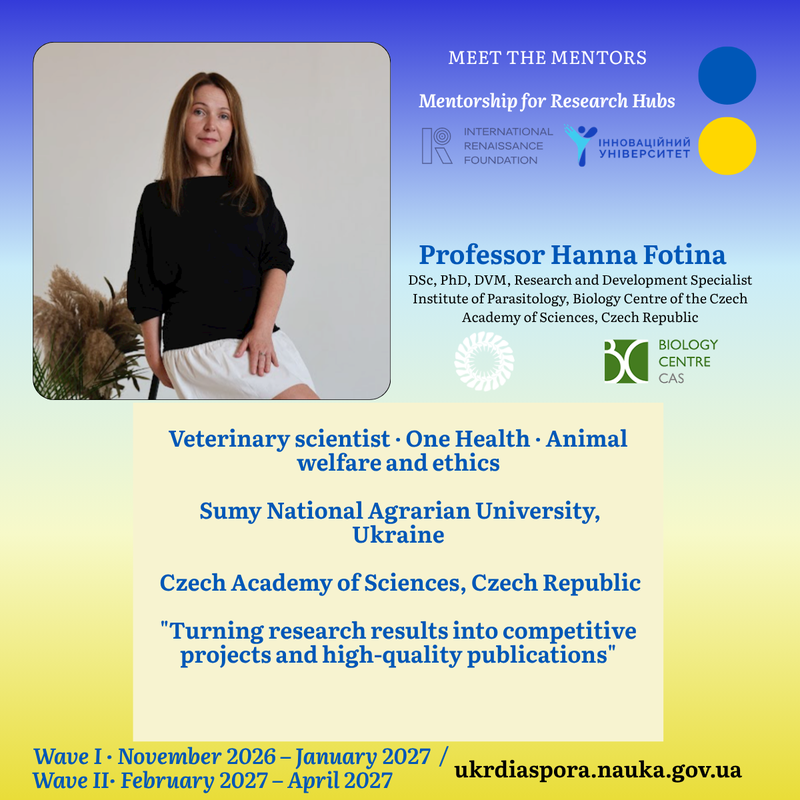
Professor Hanna Fotina is a Ukrainian veterinary scientist with more than 20 years of experience in research, university teaching, doctoral supervision and international scientific cooperation. She is a Professor at the Faculty of Veterinary Medicine of Sumy National Agrarian University and a Research and Development Specialist at the Laboratory of Molecular Ecology of Vectors and Pathogens, Institute of Parasitology, Biology Centre of the Czech Academy of Sciences.
Her work brings together veterinary medicine, experimental biology, microbiology, pharmacology and toxicology, animal welfare, food safety and the One Health approach. Her current research focuses on Borrelia infections, particularly the mechanisms and routes of non-vector transmission of borreliosis. Her earlier work on tick biology, including artificial membrane feeding as an alternative to experiments on live animals, shapes her commitment to the 3Rs principles and ethical experimental design.
Professor Fotina is the author of more than 250 scientific publications, has contributed to 12 patents and 11 registrations of veterinary medicinal products, and received the President of Ukraine Prize for Young Scientists. She is a member of the international team of the International Visegrad Fund project SURVIVE-UA: Surveillance of Vectors and Vector-Borne Infections in a War-Affected Region.
Within the Mentorship for Research Hubs programme, she can support teams in developing research concepts and experimental designs, preparing European and international funding proposals, building interdisciplinary veterinary and One Health projects, writing for international journals and responding to reviewers, applying the 3Rs and research ethics, and developing international partnerships and cooperation with industry.
"As a mentor, I would be glad to help Ukrainian research teams develop strong scientific ideas, improve their experimental design, establish international partnerships, and transform their results into competitive projects and high-quality scientific publications."