Thin-film electronics and photonics · Nanomaterials · Sensors
Aston University, Birmingham, United Kingdom
Aston Research Explorer: https://research.aston.ac.uk/en/persons/petro-lutsyk
LinkedIn: https://www.linkedin.com/in/petro-lutsyk-aston
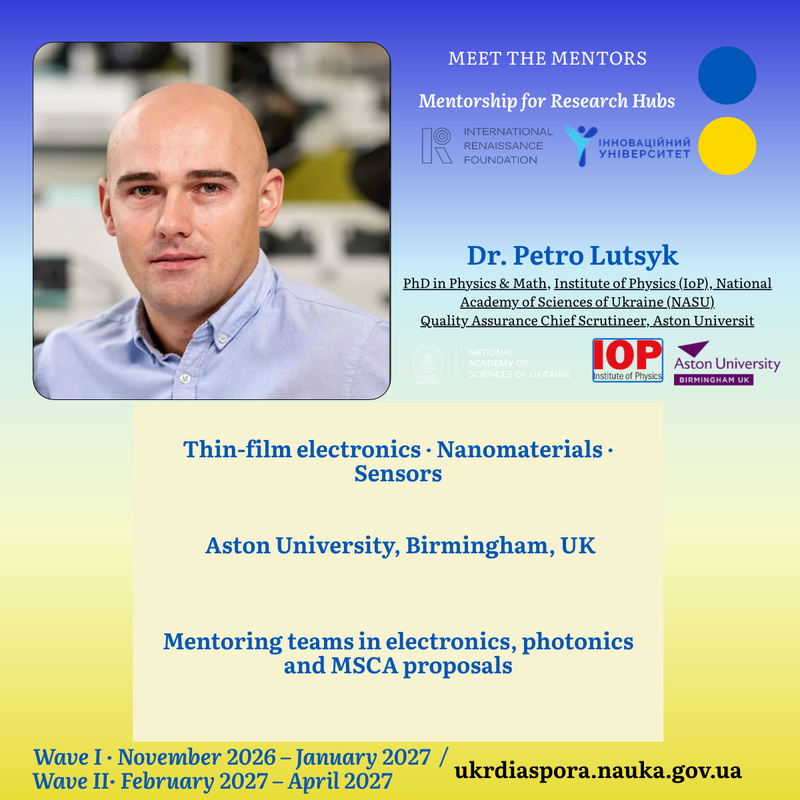
Dr. Petro Lutsyk is a Senior Lecturer in Electronic Engineering and Systems at the School of Engineering and Innovation, Aston University, Birmingham, United Kingdom, and a Senior Fellow of Advance HE. He holds a PhD in physics from the Institute of Physics of the National Academy of Sciences of Ukraine and an MSc in physics with honours from Taras Shevchenko National University of Kyiv.
His research covers thin-film electronics and photonics, nanomaterials and sensors. He works on organic and hybrid semiconductors, carbon nanotubes and nanocomposites, solar cells, transistors and optoelectronic switches, and he uses advanced spectroscopy and imaging to characterise them. As Principal Investigator of a Royal Society APEX project, he develops nanomaterial electrodes for recording brain activity.
His international career includes a Marie Curie Research Fellowship at Wrocław University of Science and Technology in Poland, a Marie Skłodowska-Curie Individual Fellowship at Aston University, research visits in Italy, the Czech Republic and Japan, and the management of a NATO Science for Peace and Security project in Ukraine. He is the author of more than 50 peer-reviewed articles, has reviewed proposals for the Horizon Europe MSCA Postdoctoral Fellowships, and has co-supervised several successful PhD students. He received the President of Ukraine Stipend for talented young scientists.
As a member of the Ukrainian Academic Diaspora in the UK, he is committed to strengthening UK–Ukraine research partnerships. Within the Mentorship for Research Hubs programme, he can support research teams working in electronics, photonics, nanomaterials and sensors, as well as in preparing grant proposals (including MSCA applications), publishing in international journals, developing international collaborations and supervising early-career researchers.