Computational linguistics · Terminology · Speech technologies
Darmstadt, Germany
LinkedIn: https://www.linkedin.com/in/maksymvakulenko/
Academia.edu: https://independent.academia.edu/VakulenkoMaksym
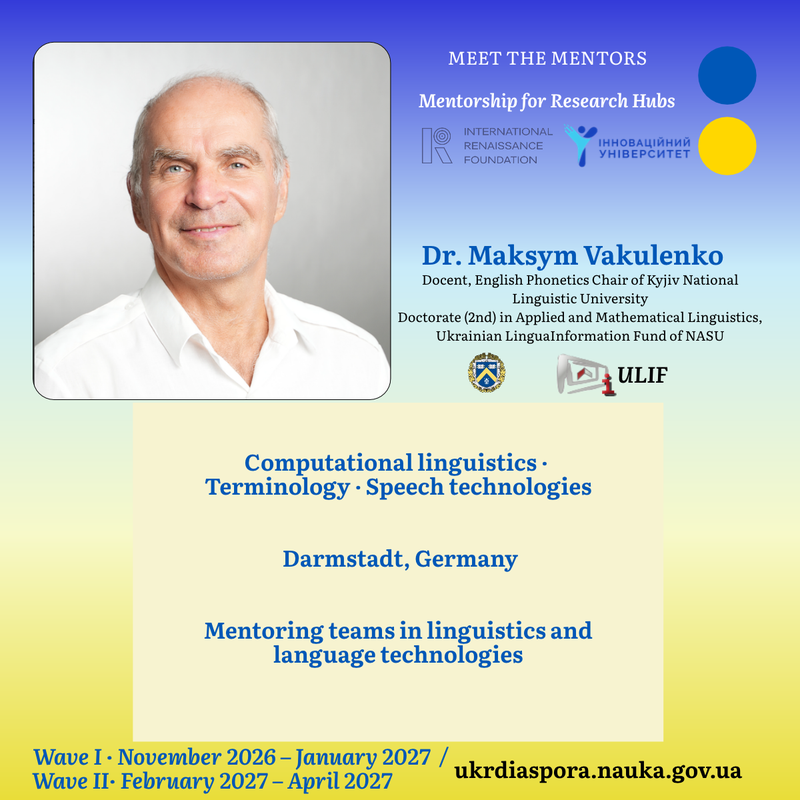
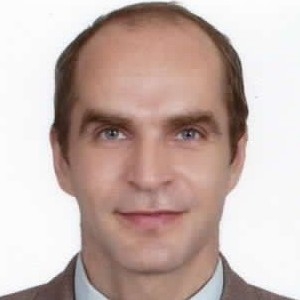
Dr. Maksym Vakulenko is a Ukrainian scholar in computational and applied linguistics whose career bridges physics, linguistics and artificial intelligence. He holds a Doctor of Sciences degree in Applied and Mathematical Linguistics from the Ukrainian Lingua-Information Fund of the National Academy of Sciences of Ukraine, and a Candidate of Sciences degree obtained after postgraduate studies at the Institute for Theoretical Physics of the National Academy of Sciences of Ukraine. He graduated with highest honours from Kyiv Taras Shevchenko State University.
His research covers semantics, terminology and terminography, acoustic phonetics, text-to-speech technologies and transliteration. Most recently, he worked as a Scientific Researcher at Darmstadt University of Applied Sciences in Germany, supported by a grant from the Hessian fund. He has also conducted research at the Institute of Problems of Artificial Intelligence, Comenius University in Bratislava, the National Library of Ukraine named after V. I. Vernadsky and the Institute of Philology of Taras Shevchenko National University of Kyiv. He headed the Experimental Phonetics Laboratory at Kyiv National Linguistic University, served as Chief Science Officer of the State Scientific and Technical Library of Ukraine, and contributed to the development of speech technologies with the Lionbridge Cognitive Sciences Team.
His recent publications include a chapter on the development of Ukrainian national terminology in the Handbook of Terminology (John Benjamins, 2025) and the entry "Transliteration" in the Encyclopedia of Slavic Languages and Linguistics Online (2024).
Within the Mentorship for Research Hubs programme, he can support research teams working in computational and applied linguistics, terminology, phonetics and speech technologies, and natural language processing, as well as in scientific writing and international publishing.