Environmental and analytical chemistry · Materials chemistry · Sustainability assessment
Linköping University, Sweden · Occupational and Environmental Medicine, Region Östergötland, Sweden
ORCID: https://orcid.org/0000-0002-2185-7885
Scopus: https://www.scopus.com/authid/detail.uri?authorId=15841900100
LinkedIn: https://www.linkedin.com/in/ivanhetman
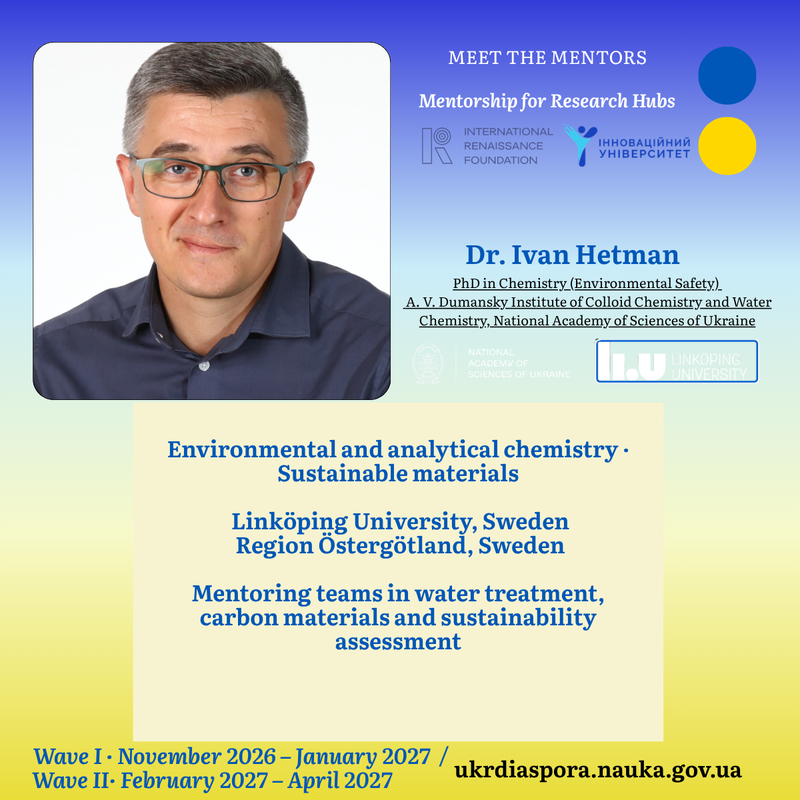
Ivan Hetman is a Docent in Materials Chemistry and Associate Professor at the Laboratory of Organic Electronics, Department of Science and Technology, Linköping University, Sweden, and a Researcher and Chemist at Occupational and Environmental Medicine, Region Östergötland. He holds a PhD in Chemistry (Environmental Safety) from the A.V. Dumansky Institute of Colloid and Water Chemistry of the National Academy of Sciences of Ukraine.
His research is mainly in environmental and analytical chemistry, materials chemistry, and sustainability assessment. He works with porous carbon materials such as activated carbon, biochar, and hydrochar for water and wastewater treatment, including adsorption, material modification, regeneration, and circular use. His work also includes chromatography and mass spectrometry for complex environmental and material-related samples, as well as life cycle assessment of environmental technologies, materials, and laboratory practices.
He has coordinated research projects funded by the Swedish Research Council Formas and the Swedish Foundation for Strategic Research and has experience in international research collaboration, research evaluation, scientific publishing, supervision, and mentoring.
Within the Mentorship for Research Hubs programme, he can support research teams with:
- developing and structuring research projects;
- preparing and critically reviewing grant proposals;
- experimental design and analytical strategy;
- developing and validating analytical methods;
- environmental chemistry, water treatment, and carbon-based materials;
- life cycle assessment and integrating sustainability into research projects;
- scientific writing and preparing manuscripts for publication;
- developing international research collaborations and professional networks;
- supervising and supporting early-career researchers.