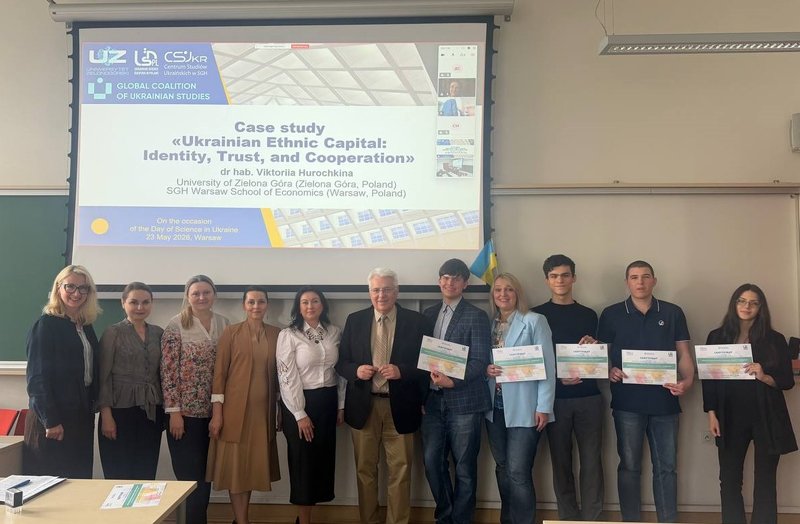
A ceremonial meeting dedicated to the Day of Science in Ukraine took place within the walls of Szkoła Główna Handlowa w Warszawie. The event was held in a friendly academic atmosphere that brought together scholars, students, representatives of Ukrainian studies, and the Ukrainian scientific diaspora in Poland. Symbolically, the conversation about Ukrainian science took place precisely in an international university environment, where knowledge becomes both an object of research and an instrument of cooperation, solidarity, and support for Ukraine.
Science diplomacy in times of crisis acquires special importance, as academic institutions, researchers, and educational networks become channels of support, representation, and international interaction. In the conditions of war, it helps preserve the presence of Ukrainian science in the global space, strengthens the voice of Ukrainian researchers, opens opportunities for partnerships, and builds trust in Ukraine as an active subject of knowledge.
One of the central elements of the meeting was the presentation of the practical case “Ukrainian Ethnic Capital: Identity, Trust, and Cooperation” by its author, Doctor of Economic Sciences, Professor Viktoriia Hurochkina. The case was developed as an international educational product for the Global Coalition of Ukrainian Studies and tested as an educational and analytical material for work with students and academic audiences.
The purpose of the case is to represent Ukrainian ethnic capital as a social resource that manifests itself through language, cultural memory, trust, horizontal ties, volunteering, joint action, and the activity of the diaspora.
The educational case on Ukrainian ethnic capital is a practice of science diplomacy - it transforms the experience of war, migration, solidarity, and social resilience into academic material suitable for teaching, discussion, and international dissemination. Through the educational format, the Ukrainian experience enters global educational circulation and becomes the basis for a broader dialogue about resilience, identity, and cooperation in times of crisis.
The special value of the case lies in the fact that it translates the Ukrainian experience of war, migration, self-organization, and solidarity into a language understandable to the international academic community. The Ukrainian experience of recent years is often described through the concepts of resilience, resistance, and mobilization. However, the case makes it possible to see the mechanism of this resilience in greater detail. How identity is supported by cultural memory, how memory and shared belonging form trust, how trust turns into horizontal networks, and how these networks turn into concrete actions of assistance, protection, advocacy, and cooperation. It is important that the material has not only didactic significance, but also research value. It contains questions for discussion, a matrix for assessing the components of ethnic capital, a block of intergenerational analysis, and tasks for group work. The case allows students to become familiar with the Ukrainian experience and independently analyze which components of ethnic capital are preserved, which are transformed, and which become vulnerable in conditions of crisis, war, or migration.
As an international educational product and a practice of science diplomacy, the case increases the visibility of Ukrainian social sciences and humanities in global educational networks, supports the development of Ukrainian studies abroad, and creates space for academic dialogue about Ukraine as an object of political support and a source of important knowledge about social resilience, trust, and solidarity.
The second part of the meeting was the presentation of the results of the study “Science Diplomacy: From Liberal Idealism to Strategic Realism,” prepared by Tomasz Szapiro, Viktoriia Yanovska, and Viktoriia Hurochkina. In the study, science diplomacy is considered as an instrument of international academic cooperation and a mechanism for preserving the scientific subjectivity of a country in conditions of war and polycrisis.
The authors argue that the full-scale war has significantly transformed the functions of science and caused a shift from science without borders as a sphere of knowledge production, academic mobility, and international partnership to an element of the system of security, crisis management, and post-war recovery.
Science diplomacy evolves from an ideal model of open science to rational, strategically oriented interaction, within which research security, institutional resilience, selectivity of international cooperation, engagement of the scientific diaspora, and protection of the country’s intellectual potential become of key importance. A particularly important element of the report was the presentation of the Institute of International Scientific Ambassadors as a new institutional instrument of science diplomacy. The status of an international scientific ambassador is unique in the world and provides opportunities to contribute to increasing the international visibility of Ukrainian science, popularizing the achievements of Ukrainian scientists, developing professional networks, initiating partnerships, and representing Ukrainian science on international academic platforms. This approach demonstrates that the Ukrainian scientific diaspora plays not an auxiliary, but a structural role. The scientific diaspora becomes an intermediary between Ukrainian science and global institutional networks, forming a space of trust, cooperation, and international recognition. The meeting at SGH showed that the Day of Science in Ukraine is an occasion for an international conversation about the future of Ukrainian science. It is precisely such educational products as “Ukrainian Ethnic Capital: Identity, Trust, and Cooperation” and the study “Science Diplomacy: From Liberal Idealism to Strategic Realism” that help integrate the Ukrainian experience into the global academic space and transform science into a form of Ukraine’s responsible presence in the world.
Within this study, “Ukrainian Ethnic Capital: Identity, Trust, and Cooperation,” an empirical measurement of the level of transmission of Ukrainian ethnic capital among three generations of migrants is being carried out:
G1 – the first generation of migrants, https://docs.google.com/forms/d/1H1bstqoOUwPr5M1Ho7ft4pPTTsFu8DuYpXIlXYQxKOk/edit
G2 – the second generation, born or socialized outside Ukraine, children of migrants https://docs.google.com/forms/d/1-g5vNgA-up6yGa2QSAjiX6izSnRg1oMeQ_bGoISFdks/edit and
G3 – the third generation, grandchildren of migrants or representatives of further generations of the Ukrainian diaspora https://docs.google.com/forms/d/1y_mEiQ4gPEJiM0PLbjL09q70MH102x3osReNIl4ZASQ/edit
We invite representatives of all three generations to join the study by filling out the appropriate questionnaire form. The data obtained will allow for a comparative intergenerational analysis of the preservation and transformation of cultural memory, identity, trust, and practices of collective action in Ukrainian communities abroad.
Participation in the study is anonymous and aimed at the scientific generalization of the processes of reproduction of ethnic capital in conditions of migration and global mobility.